
History of the Monkey Gland
- Origin
- Harry's New York Bar, Paris
- Created
- 1920s
- Created by
- Harry MacElhone
- Named after
- Serge Voronoff's monkey-gland grafting experiments
- Family
- Shaken
In the 1920s the surgeon Serge Voronoff became famous, and notorious, for grafting slices of monkey tissue onto men in an attempt to restore their youth. Paris was fascinated, and Harry MacElhone of Harry's New York Bar named a new drink after the craze: gin and orange juice with grenadine and a touch of absinthe.
The drink was popular enough to appear in the Savoy Cocktail Book in 1930. Voronoff's treatments were later discredited.
Fun Facts
- MacElhone also popularised the Bloody Mary and the French 75.
- Some versions use Bénédictine instead of absinthe.
- The grenadine gives it a sunset colour.
Variations
| Variation | What changes |
|---|---|
| Bénédictine version | Bénédictine instead of absinthe |
| Bronx | Vermouths instead of grenadine |
Monkey Gland FAQ
Why is it called a Monkey Gland?
After a 1920s medical craze in which surgeon Serge Voronoff grafted monkey tissue onto patients.
What is in a Monkey Gland?
Gin, orange juice, grenadine and a little absinthe.
Who created it?
Harry MacElhone, at Harry's New York Bar in Paris.
What glass is a Monkey Gland served in?
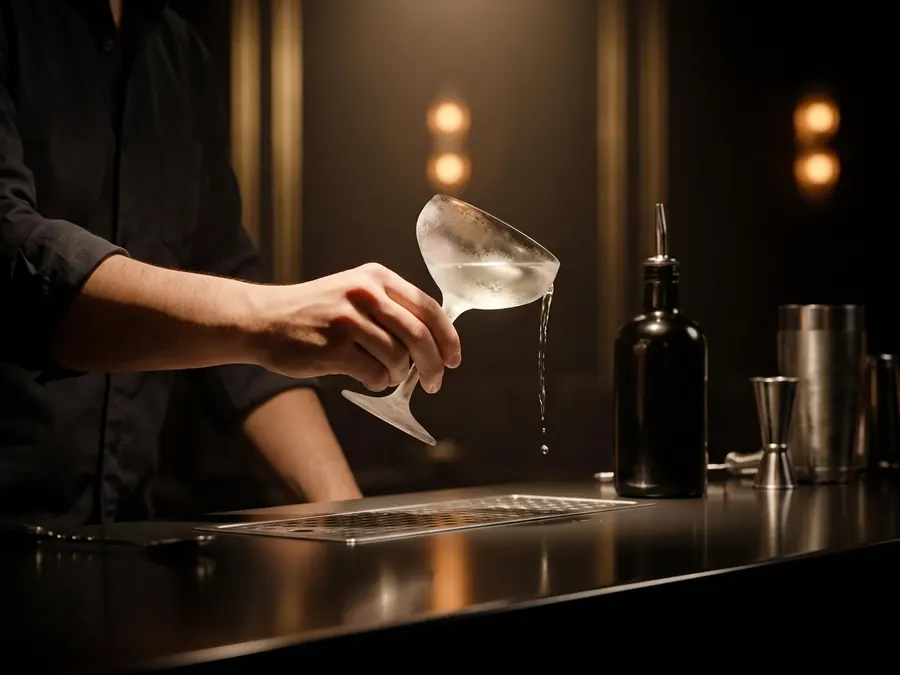
A coupe. The stem keeps your hand away from the cold drink, and the curved rim makes it far harder to spill than a V-shaped martini glass.
Is a Monkey Gland shaken or stirred?
Shaken. It contains citrus, juice, cream or egg, which need the force and aeration of shaking.
How strong is a Monkey Gland?
About 13% ABV after dilution, or roughly 1 US standard drinks (14 g of alcohol) per serve.
How many calories are in a Monkey Gland?
Roughly 140 kcal per drink, most of it from alcohol.
Can I make a Monkey Gland without London dry gin?
Yes. Vodka is the closest substitute, though the drink will taste different.


